// PROJECT SUMMARY
ENSO Heart is a compact, battery-powered device built around a patented method for meditation and relaxation. The concept combines guided meditation with the user's own heartbeat, captured directly from the chest and mixed with pre-recorded audio.
JPM Systems developed the complete electronic platform, integrating heartbeat sensing, audio processing, a touchscreen interface, Bluetooth connectivity and rechargeable battery power into a highly miniaturized device.
The project also became an important lesson in product development: more functionality does not always result in a better first product.
// THE PROBLEM
The customer had developed and patented a method for meditation and relaxation in which users listen to their own heartbeat while following guided meditative content.
The challenge was to turn this concept into a standalone physical product.
The device needed to detect the user's heartbeat directly from the chest, reproduce it through headphones together with pre-recorded meditation audio, and provide a simple interface for controlling the experience.
At the same time, the complete system had to remain compact, portable and battery-powered.
// THE SOLUTION
We developed a custom electronic device that users place on their chest to capture their heartbeat using an acoustic sensing principle similar to a stethoscope.
The detected heartbeat is processed and mixed in real time with preloaded guided meditation audio, allowing users to hear their own body as part of the meditation experience.
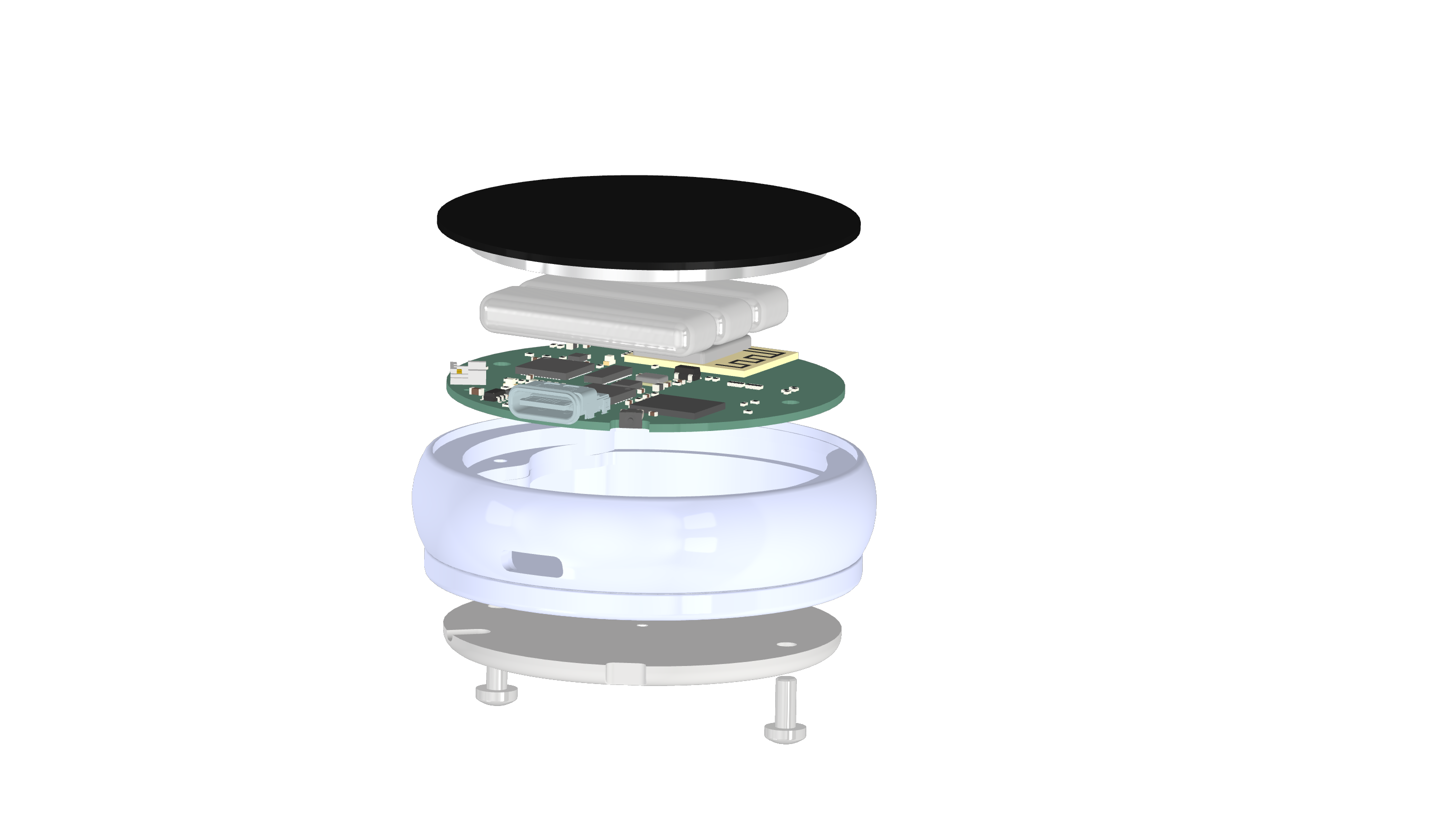
The device combines several subsystems within a compact enclosure, including heartbeat sensing, audio processing and mixing, local audio storage and playback, a touchscreen user interface, Bluetooth connectivity, rechargeable battery management and the supporting embedded electronics.
Achieving all of this within a small portable device required a high level of electronics integration and miniaturization.
// OUR WORK
JPM Systems was responsible for:
- – Product and system architecture
- – Custom electronics development
- – PCB design
- – Heartbeat sensor integration
- – Acoustic signal processing
- – Audio electronics
- – Real-time audio mixing
- – Audio playback and storage
- – Touchscreen integration
- – Bluetooth connectivity
- – Embedded firmware development
- – Rechargeable battery integration
- – Battery management
- – Power supply design
- – Low-power design
- – Electronics miniaturization
- – Prototype development
- – System integration
- – Testing and validation
// KEY CHALLENGES
Detecting and Reproducing the Heartbeat
The fundamental technical challenge was capturing a usable heartbeat signal from a compact sensor placed against the user's chest.
The signal then had to be processed and reproduced as part of the audio experience while remaining synchronized with what the user was actually experiencing.
Real-Time Audio Integration
The heartbeat was only one part of the experience.
The device also needed to store and play guided meditation recordings and combine them with the live heartbeat signal. This required integrating sensing, signal processing, audio playback and mixing into a single embedded system.
Miniaturization
The product combined functionality that would normally be distributed across several devices: sensing, audio processing, storage, Bluetooth, a graphical user interface and battery power.
Integrating all of these systems into a small enclosure required careful PCB design, component selection, mechanical integration and power-system design.
The Complexity–Battery–Size Triangle
During development, additional functionality was gradually introduced into the product.
Each feature appeared manageable individually, but together they significantly increased system complexity and power consumption.
Higher power consumption reduced battery life. Increasing battery capacity would then require more physical volume, directly conflicting with the requirement for a small and compact device.
The project demonstrated how tightly connected functionality, power consumption, battery life and physical dimensions become when developing a compact electronic product.
An Important Product Development Lesson
One of the most valuable outcomes of the project was not purely technical.
As development progressed, the scope continued to expand. Instead of protecting a clearly defined minimum viable product, we attempted to incorporate too much of the final product vision into the first development cycle.
The customer was developing a hardware product for the first time, and we should have challenged the growing scope more strongly.
A better approach would have been to develop a focused MVP, put it into the hands of real users, validate the core experience and only then decide which additional functionality justified the resulting cost, complexity and power requirements.
That lesson has influenced how we approach product development today: our responsibility as a development partner is not only to build what is requested, but also to challenge what should be built — and when.
// THE RESULT
The project resulted in a highly integrated functional device combining heartbeat sensing, real-time audio processing, guided audio playback, touchscreen interaction, Bluetooth connectivity and rechargeable battery power in a compact platform.
It demonstrated that the patented meditation concept could be translated into a standalone electronic product and provided a technical foundation for further development.
Just as importantly, the project strengthened our approach to MVP development and product engineering.
Successful product development isn't about putting every possible feature into version one. It is about identifying the core value, building enough to validate it with real users, and allowing evidence from the market to guide the next engineering decisions.