// PROJECT SUMMARY
ElderON was our first technology business and one of the projects that most strongly shaped how we approach product development today.
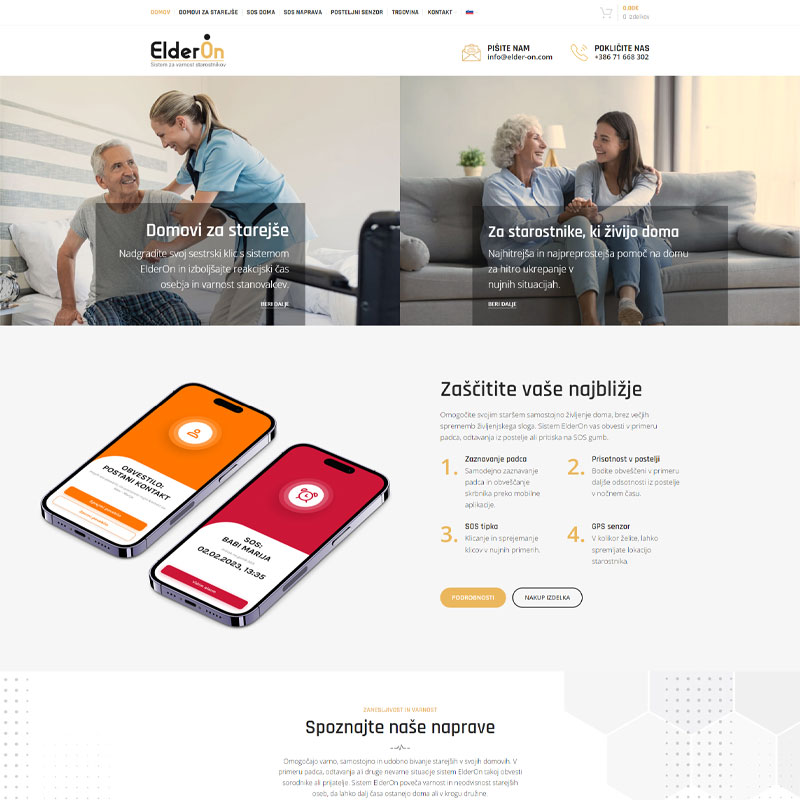
We developed a contactless bed-monitoring system for elderly care capable of detecting presence, movement, breathing and heart rate through a mattress.
The technology was applied primarily to dementia care, where nighttime wandering creates a significant challenge for caregivers. Instead of generating an alarm every time someone leaves their bed, ElderON learned individual routines and notified caregivers only when someone's behavior deviated from what was expected.
// THE PROBLEM
Nighttime wandering is common among people living with dementia.
Caregivers cannot continuously monitor every resident, while simple bed-exit alarms create another problem: they generate an alert every time someone leaves the bed, including completely normal situations such as going to the bathroom.
This can result in unnecessary alarms and additional workload for already busy care staff.
A useful system therefore needed to understand more than simply: is the person in bed or not? It needed to consider: is what is happening normal for this particular person?
// THE SOLUTION
We developed ElderON, a non-invasive bed-monitoring system installed underneath the mattress.
The sensing technology could detect extremely small movements through the mattress, allowing the system to determine bed presence and extract physiological information such as breathing and heart rate without requiring the resident to wear a device.
The system then used this information together with individual behavioral patterns to determine when caregivers actually needed to be notified.
For example, if a resident regularly leaves the bed for five minutes during the night, there is little value in immediately generating an alarm. ElderON could instead allow an individually configured period — for example eight minutes — before notifying a caregiver.
The goal was to move from simple monitoring toward context-aware elderly care.
// OUR WORK
JPM Systems was responsible for:
- – Product concept development
- – Custom hardware development
- – Sensor development and integration
- – Analog signal processing
- – Custom electronics development
- – PCB design
- – Embedded systems development
- – Firmware development
- – Breathing and heart-rate detection
- – Bed-presence detection
- – Signal-processing algorithms
- – Behavioral monitoring logic
- – Backend development
- – User interface development
- – Alert and notification systems
- – Prototype development
- – Field testing in elderly-care environments
- – Product industrialization
- – Manufacturing preparation
- – Customer validation
- – Business-model development
- – Go-to-market
// KEY CHALLENGES
Detecting Vital Signals Through a Mattress
The sensing system had to detect extremely small movements without requiring anything to be attached to the person.
Signals caused by breathing and heartbeat had to be extracted through the mattress while distinguishing them from larger body movements and environmental disturbances.
This required a combination of sensing, custom electronics, signal processing and algorithm development.
Reducing Alarm Fatigue
Simply detecting that someone had left the bed wasn't enough.
A system that alerts caregivers every time a resident goes to the bathroom would quickly become more of a burden than a solution.
We therefore developed logic around individual behavior and configurable response times so that alerts could better reflect the habits of each resident.
The objective wasn't to generate more information. It was to generate the right alert at the right time.
Technology First vs. Problem First
ElderON also taught us one of our most important product-development lessons.
The project initially started with interesting sensing technology. Only afterwards did we search for the strongest problem that the technology could solve.
Fortunately, we found a real application in elderly care — but the experience fundamentally changed how we approach new products.
Today, we strongly prefer to begin with problem → customer → validation → solution → technology rather than technology → solution → search for a problem. Great technology can enable a product, but technology alone doesn't create a market.
Nice-to-Have vs. Must-Have
Nighttime monitoring provides clear benefits for care facilities, but another important question emerged: how painful is the problem, and how much is the customer willing to pay to solve it?
There is an enormous difference between people agreeing that a product is useful and being willing to allocate budget to it.
ElderON received significant positive feedback and public attention. People supported the idea of using technology to improve elderly care. But positive feedback doesn't necessarily equal purchasing behavior.
Asking Customers to Vote With Their Wallets
Perhaps the most important business lesson from ElderON was learning the difference between stated interest and validated demand.
If you ask someone whether better technology should be available for elderly care, the answer will almost always be yes.
The much more valuable question is: will you pay for it?
Real validation happens when customers commit — through a purchase, pilot, deposit, contract or another meaningful action.
That lesson now influences how we approach MVP development and customer validation before investing heavily in engineering.
// THE RESULT
ElderON resulted in a working contactless monitoring platform combining custom sensors, electronics, embedded systems, signal processing, software and behavioral monitoring.
But its impact on us went beyond the technology.
As our first business venture, ElderON taught us how different building a product is from building a business around a product.
It shaped principles we still use when working with customers today: validate the problem before over-engineering the solution, identify whether the product is a must-have or a nice-to-have, build an MVP early, and look for real customer commitment rather than positive feedback alone.
ElderON therefore represents both where our product-development journey started and many of the lessons that define how we develop products today.